
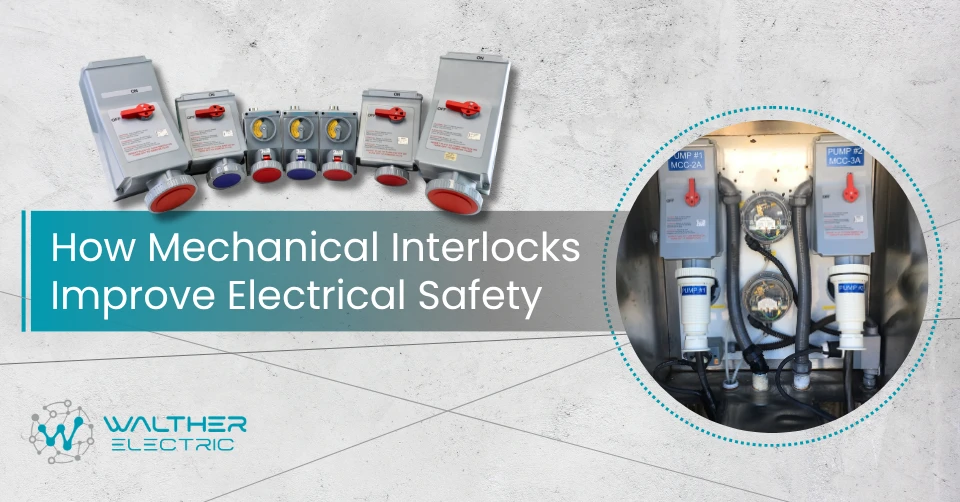
When electrical equipment needs to be connected or disconnected, power should be switched OFF before the plug is inserted or removed.
A mechanical interlock builds that sequence into the equipment itself.
Walther Electric Mechanical Interlocks combine a switch and receptacle in one device. The plug can only be inserted or removed while the switch is OFF. Once the switch is turned ON, the plug is mechanically locked in place.
The principle is simple: power must be off before the electrical connection can be physically made or broken.
Why the Sequence Matters
Connecting equipment and switching an energized circuit are two different operations.
A mechanical interlock physically links the two and enforces the right order.
But why does the power need to be switched off first?
Plugs and receptacles are designed to make electrical connections safely, and we routinely plug in electrical equipment every day without shutting off the entire circuit.
→ The important distinction is whether equipment is energized when the plug is removed. In electrical terms, that’s disconnecting under load.
When electrical contacts begin to separate while current is still flowing, electricity can arc across the opening between them. In industrial applications with higher electrical demands, controlling that interruption is critical to limiting electrical hazards and protecting equipment from damage.
That's why the switch has a separate job. Walther's switch-equipped Mechanical Interlocks are designed and certified to perform the switching operation at their full rated current and voltage.
|
The switch interrupts the current. |
Lockout Keeps OFF in the OFF Position
Switching equipment OFF is one step. Making sure it stays OFF during service or maintenance is another.
Walther Mechanical Interlocks support lockout/tagout procedures through the operating handle. Once switched OFF, the handle can be padlocked in that position so the equipment cannot be re-energized until the lock is removed.
Lockout capability does not replace workplace procedures or training.
It simply provides a physical means of keeping the switch OFF while those procedures are carried out.
Designed for the Installation
The interlocking mechanism is the core of how the device operates, but it's not the only part of the design that matters. Walther Mechanical Interlocks also include practical features for mounting, environmental protection, and easy identification.
Those details provide more options for integrating the interlock into an industrial installation:
| Feature |
What it Adds |
|
Compact enclosure |
Fits within the web of an 8" column |
|
Multiple knockouts |
Provides options for conduit entry |
|
Swivel-mount feet |
Simplifies mounting in tight or irregular locations |
|
Color-coded covers |
Helps identify the correct mating device |
|
NEMA 4X, 12K enclosure |
Protection for demanding environments |
Adding a Walther Mechanical Interlock doesn't necessarily mean replacing compatible plugs already in use. The receptacles are designed for Walther IEC 60309 plugs but can also be used with other manufacturers' plugs that conform to the same IEC 60309 standards and color-coding system.
Safety Built Into the Sequence
Procedures and training tell operators how equipment should be used.
A mechanical interlock goes one step further by ensuring the correct sequence is part of how the equipment operates.
When the switch is ON, the plug is locked in place. It cannot be removed until the switch is turned OFF.
The result is a safety measure that exists not only as an instruction, but as a physical function of the equipment.
Walther Electric offers Mechanical Interlocks in configurations designed for a range of electrical systems, installations and operating environments.
Shop Products: Walther Electric Mechanical Interlocks