
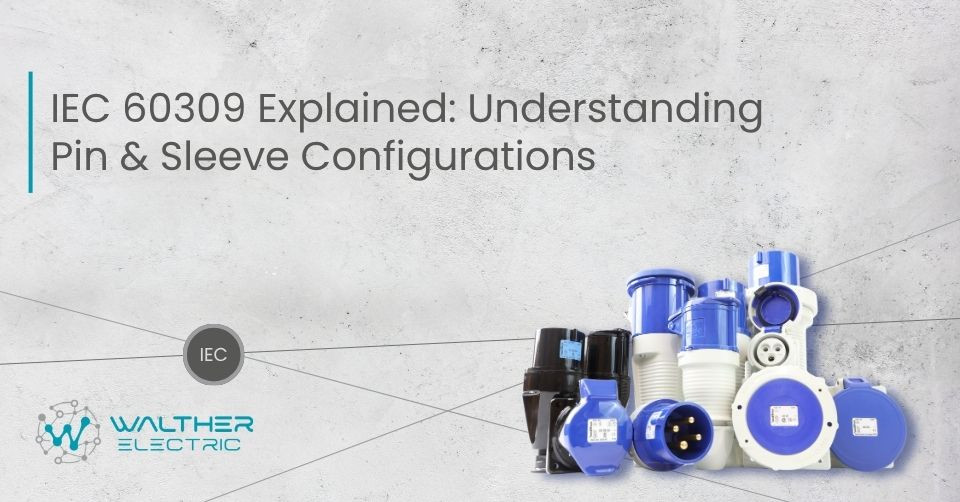
Selecting the right IEC 60309 Pin & Sleeve device starts with understanding its configuration.
At first glance, an IEC 60309 catalog can look overwhelming. There are dozens of plugs, connectors, receptacles, and inlets that appear nearly identical. In reality, they are not redundant — they are intentionally configured to match different electrical systems, environments, and applications.
That standardization is what makes IEC 60309 devices so versatile. Rather than creating a one-size-fits-all connector, the IEC 60309 standard defines a system of configurations that allows engineers to select a device built specifically for the application.
Once you understand the five key configuration choices behind every IEC 60309 device, the product line becomes much easier to navigate.
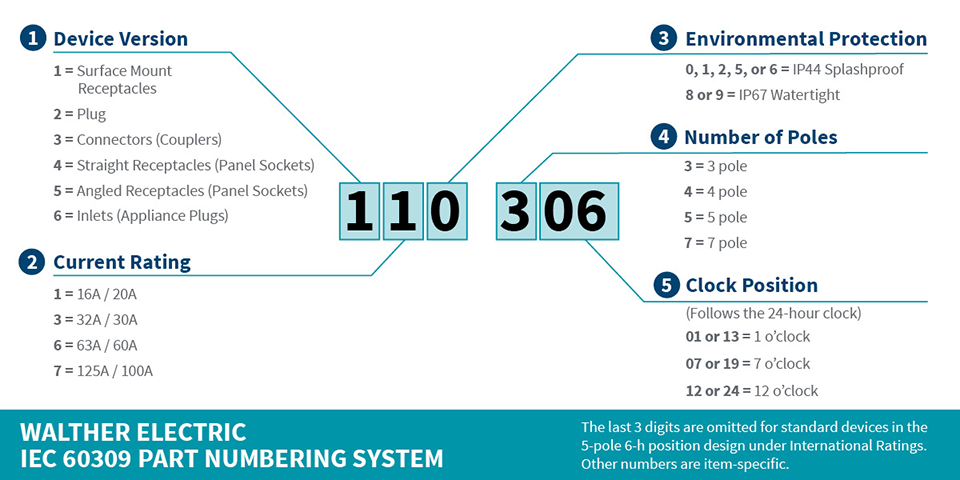
Every IEC 60309 Device Is Defined by Five Configuration Choices
| Configuration |
What It Defines |
|
① Device Version |
Plug, Connector, Receptacle, or Inlet |
|
② Current Rating |
Available amperage |
|
③ Environmental Protection |
Splashproof or Watertight construction |
|
④ Number of Poles |
Number of poles and wires |
|
⑤ Clock Position |
Voltage and frequency compatibility, |
Walther Electric's IEC 60309 part numbers simply organize these five configuration choices into a consistent model numbering system. You don't need to memorize every number — but understanding what each section represents makes it much easier to compare devices and identify the configuration that's right for your application.
① Device Version: How Will Power Connect?
The first part of every Walther Electric IEC 60309 model number identifies the product family. This may refer to the connection type (plug, connector, inlet) or, in the case of receptacles, the mounting style or housing configuration.
| Device |
Purpose |
Image |
|
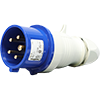
Plug |
A cable-mounted device that inserts into a receptacle to receive power from a fixed source. |
|
|
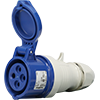
Connector |
A cable-mounted device that accepts a plug, allowing power to be extended to downstream equipment. |
|
|
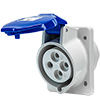
Receptacle |
A fixed outlet mounted to equipment, panels, or walls that supplies power to a plug. |
|
|
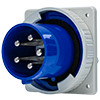
Inlet |
A fixed device mounted to equipment that receives power from a connector. |
|
② Current Rating: How Much Power Is Required?
The next consideration is current capacity.
IEC 60309 devices are available in a variety of current ratings. Some products are listed with a single current rating, while others carry dual ratings — such as 16A/20A or 32A/30A — to reflect both International and North American standards.
| North American |
International |
|
20A |
16A |
|
30A |
32A |
|
60A |
63A |
|
100A |
125A |
③ Environmental Protection: Where Will It Be Used?
Not every electrical connection operates in the same environment.
Some applications require protection from occasional splashing water, while others demand watertight connections capable of withstanding repeated outdoor use or washdown conditions.
Walther Electric offers IEC 60309 devices in multiple environmental versions to match those conditions, including splashproof (IP44) and watertight (IP67) configurations.
|
If you're unfamiliar with ingress protection (IP) ratings, our recent article, Environmental Ratings: What IP44, IP67, and NEMA Really Mean, explains how to match the right level of protection to your application. |
④ Number of Poles: How Is Power Carried?
Current rating tells you how much power a device can carry. Pole configuration tells you how that power is delivered by identifying the number of current-carrying conductors, neutral conductors, and grounding conductors.
Common pole configurations include:
| Configuration |
Typical Application |
|
1P + N + G |
One pole with neutral and ground for single-phase applications |
|
2P + G |
Two poles with ground |
|
3P + G |
Three poles with ground for three-phase applications |
|
3P + N + G |
Three poles with neutral and ground for three-phase applications |
|
6P + G |
Six poles with ground for specialized industrial applications |
⑤ Clock Position: Is It Compatible?
One of the most recognizable features of IEC 60309 devices is the clock position.
Rather than placing the grounding pin in the same location on every connector, the IEC 60309 standard positions it like the hand of a clock. Each clock position corresponds to a specific voltage and frequency configuration, preventing incompatible equipment from being connected together.
Although two connectors may look nearly identical, different clock positions ensure they can only mate with equipment designed for the same electrical system.
Designed for the Application
At first glance, IEC 60309 devices can appear to be a long list of similar-looking products. Once you understand the five configuration choices behind each device, it becomes clear that every variation serves a specific purpose.
Whether you're specifying temporary power for a jobsite, replacing an existing connector, or designing a new electrical system, understanding these core configurations helps you narrow the field and ask the right questions.
You don't need to memorize every product or configuration — that's what Walther Electric's engineering and sales teams are here for. But knowing how IEC 60309 devices are organized makes it easier to identify the right solution and confidently plan your next project.
View Catalogs: IEC 60309 Pin & Sleeve Devices
Shop Products: IEC 60309 Plugs, Connectors, Receptacles, & Inlets