
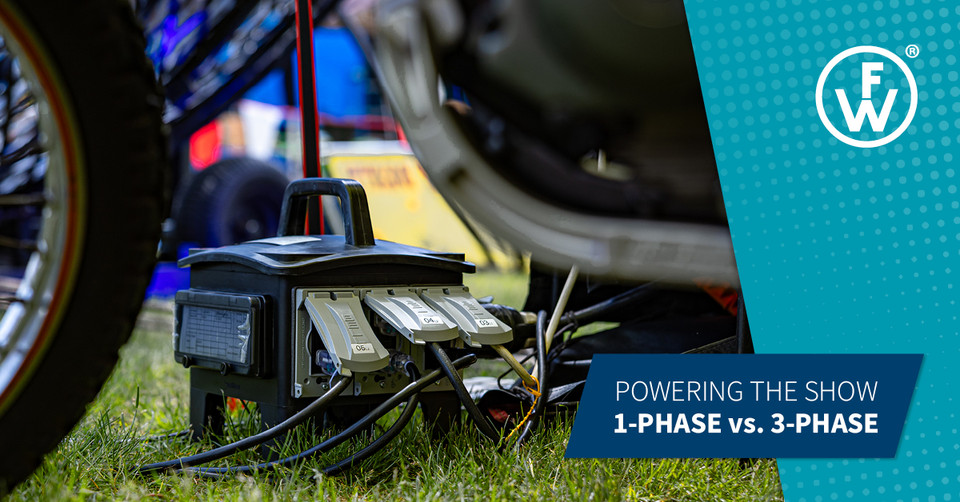
Temporary power for live events has become more complex than ever. Outdoor concerts, trade shows, broadcast stages, and mulit-vendor environments all rely on equipment with diverse electrical requirements. Lighting rigs, LED walls, audio systems, cooling units, POS systems, and vendor booths often operate on different types of power — each contributing to the full picture of the event.
One of the biggest decisions in event power distribution is choosing the right mix of single-phase vs. three-phase power. The power type affects load capacity, cable routing, equipment compatibility, and how portable power distribution units (PDUs) and IEC 60309 pin and sleeve connectors are deployed across a site.
When to Use Single-Phase Power in Live Event Setups
Single-phase power supplies the general-use equipment that keeps the event functioning. It’s widely available, widely compatible, and easy to distribute across long distances.
Typical single-phase applications include:
- Vendor booths and concessions
- Ticketing and check-in systems
- Small AV gear (mixing stations, monitors, projectors)
- Accent lighting and décor
- Operations trailers or command posts
- Charging or workstation areas
This is the foundational power layer that spreads across the venue. It provides stable, predictable power where demand is moderate and equipment is diverse enough to handle most live event needs.
When Three-Phase Power Is Necessary for Production
Three-phase power is what production crews lean on for equipment that draws more current or demands balanced loads. Its strength is capacity — and stability under heavier demand.
Three-phase is commonly used for:
- LED video walls and processors
- High-output sound reinforcement systems
- Moving-head or high-intensity lighting arrays
- Broadcast or server racks
- Large motors (pumps, lifts, fans)
- High-density charging or power conditioning equipment
Three-phase isn’t “better” — it’s simply built for equipment with large, dynamic loads that would overwhelm a single-phase circuit.
How Temporary Power Distribution Works at an Event Site
Most temporary event setups follow a similar distribution structure, regardless of layout:
1) Three-phase power enters the site
From a generator, venue panel, or temporary facility tap.
2) A PDU divides that feed into usable circuits
208V three-phase circuits for production, 120V single-phase circuits for distributed loads.
3) Connectors match the distribution plan
IEC 60309 for keyed, high-capacity circuits; camlock for feeder lines; NEMA for equipment-level plug-in.
4) Cable assemblies carry power where it’s needed
Across the stage, truss, front of house positions, vendor rows, or backstage zones.
This structure keeps the system predictable and scalable as gear is added, removed, or repositioned to fit the needs of the live event.
Common Questions About Live Event Power (FAQ)
1. “Why can’t everything run off single-phase?”
Large-scale production equipment often draws more current than single-phase circuits can support. Distributing these loads across multiple legs of a three-phase feed helps avoid unnecessary breaker trips and reduces strain on any single conductor.
2. “Do small outdoor events really need three-phase?”
Not always. Smaller stages or vendor-driven events may rely primarily on single-phase. But as soon as LED walls, larger PA systems, or moving-head lighting enter the picture, three-phase becomes practical — even at mid-sized productions.
3. “How do I prevent one phase from carrying most of the load?”
Balancing is handled during planning and by using appropriately configured PDUs. Clear labeling and segmented distribution points help crews spread equipment evenly as the event scales.
4. “What connectors should I expect on-site?”
IEC 60309 Pin & Sleeve connectors are common because they are keyed by voltage and structural configuration. This ensures only matching devices connect. Camlock connectors are typical for generator tie-ins and feeder runs, while NEMA devices remain standard at the equipment level.
Walther Electric Solutions for Live Event Power Distribution
Walther Electric’s portable power solutions fit naturally into event power distribution planning because they are designed for flexibility, field practicality, and compatibility with common production workflows.
Portable Power Distribution with Walther PDUs
Walther Portable Power Distribution Units (PDUs) help event crews break down three-phase sources into organized, usable circuits that support both production equipment and general operations. Walther PDUs offer:
- 20A to 400A ratings
- Single- or three-phase configurations
- Multiple output types (IEC, Camlock, NEMA, CS-type, and others)
- Clearly labeled, breaker-protected circuits
- Optional NEMA 3R enclosures for outdoor use
These units simplify distribution by creating structured circuits that match the needs of specific equipment zones.
IEC 60309 Connectors for Event and Entertainment Power Systems
Walther IEC 60309 Pin & Sleeve connectors are widely used in temporary event power because they provide predictable, keyed alignment that prevents voltage or configuration mismatches. What they support:
- Keyed, voltage-specific alignment
- Rugged housings appropriate for event and touring environments
- Compatibility with common generator and distribution standards
- Predictable integration with rental and staging equipment
Because these connectors physically cannot be mismatched by voltage or configuration, they help maintain consistency across mixed gear and multi-vendor setups.
Cable Assemblies and Adapters for Flexible Event Power Routing
Walther cable assemblies and threaded adapters simplify routing from PDUs to equipment zones while supporting overhead, ground, and cross-venue transitions. They make setup smoother by allowing crews to:
- Transition between overhead or ground-level routing
- Adapt to international equipment
- Reduce setup time during large productions
- Connect gear from multiple vendors using standard interfaces
These assemblies bridge the gaps between generator feeds, PDUs, stage equipment zones, front of house positions, and vendor areas.
Final Takeaway: Build Power Around the Equipment
Live events rely on a hybrid of single-phase and three-phase power. Knowing when to use each type leads to better planning, cleaner routing, fewer surprises, and smoother production days.
Walther Electric supports event teams by helping them:
- Integrate high- and low-draw gear within one distribution plan
- Break down three-phase feeds cleanly with structured PDUs
- Keep connections consistent with IEC 60309 systems
- Route power efficiently across stages, front of house, vendor rows, and support areas
Whether it’s a concert stage, a trade show floor, or a multi-vendor outdoor event, Walther provides the components and configurations needed to keep power distribution structured, flexible, and ready for real-world conditions.
Explore Catalogs: Electrical Product Catalogs
Shop Products: Find Your Event Equipment