
Designing Flexible Power Paths in Data Centers: Overhead vs Underfloor Power
In a data center, power routing decisions don’t just affect installation day — they shape how easily the facility can grow, adapt, and stay efficient for years to come. Choices made early about overhead versus underfloor power paths influence airflow, maintenance access, and how smoothly future changes can be made.
As rack densities increase and cooling strategies evolve, engineers are being asked a harder question: How do we design a power distribution system that works today — without limiting tomorrow? Understanding the trade-offs between overhead and underfloor routing — and the interface components that connect those paths — is key to building power infrastructure that stays flexible as demands change.
Why Power Routing Decisions Matters in Modern Data Centers
Overhead and underfloor power distribution each serve different operational priorities, and neither is universally “better.” The right approach depends on rack density, cooling design, and how frequently the environment is expected to change.
- Underfloor power routing has long been paired with raised-floor cooling designs. When cable trays are properly sized and well managed, they can accommodate a substantial amount of cabling. Over time, however, unused or legacy cables often remain under the floor, contributing to congestion that can interfere with airflow and complicate cooling management.
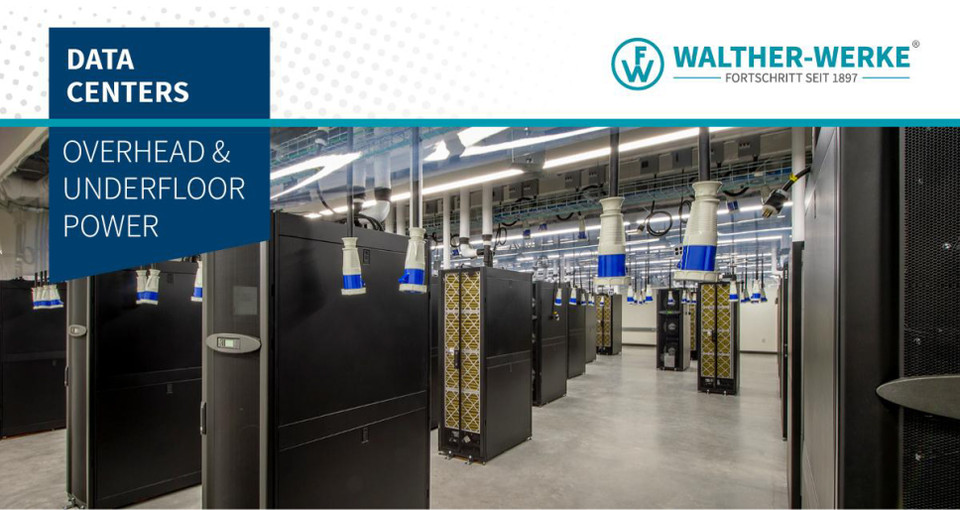
- Overhead power routing helps alleviate these challenges by keeping cabling out of the underfloor HVAC. This approach supports clearer airflow paths and allows technicians to access power infrastructure without lifting tiles or disturbing cooling zones. Overhead systems are also well suited for facilities that expect frequent layout changes or equipment refreshes.
In practice, many facilities adopt a hybrid strategy — selecting overhead, underfloor, or combined routing based on the specific demands of each space.
Key Design Factors That Infl uence Power Routing Choices
Cooling Performance and Airflow Management
Power routing decisions directly affect cooling performance. Overhead pathways can help preserve underfloor space for HVAC and air delivery systems, reducing the risk of airflow blockage caused by accumulated cabling. They also support modular layouts where racks are not constrained by fixed floor penetrations.
Underfloor cabling can offer a cleaner visual footprint above the floor, but it requires disciplined cable management. Congested trays, abandoned cables, and poorly sealed cutouts can all impact cooling efficiency over time.
Accessibility, Maintenance & Reconfiguration
Data centers rarely stay static. Equipment is added, relocated, or replaced throughout the facility’s life cycle.
Overhead power routing generally provides easier access for maintenance and reconfiguration, allowing technicians to work without disrupting cold aisle or hot aisle containment. Underfloor systems, while protected from overhead impacts, often require tile removal and careful coordination around cooling infrastructure to make changes.
The more frequently a space is expected to evolve, the more important accessibility becomes.
Planning Power Interfaces at the Rack Level
Regardless of the routing method, power distribution ultimately converges at the rack row or equipment interface. Planning these connection points early reduces complexity during installation and future changes.
Typical considerations include:
- Standardized connector types for predictable integration
- Threaded adapters for international or mixed equipment environments
- Cable assembly choices that support both overhead trays and underfloor trays
Standardized interfaces reduce engineering friction when equipment is sourced globally or migrated between locations.
Overhead vs Underfloor Power: Advantages and Trade-offs
Overhead Power Distribution
- Advantages:
- Easier access for maintenance and expansion
- Reduced underfloor cable congestion
- Less interference with airflow and cooling systems
- Considerations:
- Requires planning for ladder access or overhead infrastructure
- May be constrained by ceiling height
- Cable ampacity can be influenced by hot aisle airflow conditions
Underfloor Power Distribution
- Advantages:
- Components remain out of sight
- Direct access under raised floor for some installations
- Considerations:
- Cable accumulation can obstruct airflow
- Modifications often require tile removal
- Poorly sealed cutouts can contribute to air leakage
Designing Data Center Power Infrastructure for Long-Term Change
Power infrastructure in a data center is rarely permanent. Capacity increases, rack additions, and equipment refresh cycles are ongoing realities.
- Facilities teams often face recurring questions:
- How easily can future power paths be accessed?
- Can connectors adapt to different rack layouts?
- Do routing choices interfere with airflow patterns?
- How are additional circuits integrated without disrupting cooling infrastructure?
Designing with modular, standardized components — such as IEC connectors, threaded adapters, and flexible cable assemblies — allows teams to respond to change without rebuilding entire power paths.
The Role of Interface Components in Flexible Power Distribution
Adapters, connectors, and cable assemblies are often treated as secondary details, but in practice they play a central role in long-term flexibility.
- Threaded adapters (Metric ↔ NPT, PG ↔ NPT) allow power feeds to connect across international and regional conduit standards without custom modification.
- Cable assemblies, including color-coded options, support organized transitions at overhead tray exits or underfloor entry points.
- Connector standards, such as IEC configurations, provide predictable endpoints for rack-level power and busway integrations.
By planning these interfaces as part of the overall power strategy, teams reduce installation uncertainty and simplify future changes.
Design Power Systems for Change, Not Just Initial Installation
In modern data centers, the real challenge isn’t choosing overhead or underfloor power — it’s designing a system that can adapt as layouts shift, equipment changes, and capacity grows.
Power paths that are easy to access, reconfigure, and connect reduce disruption and help facilities evolve without major rework.
That adaptability often comes down to the details: standardized connectors, flexible cable assemblies, and threaded adapters that bridge global equipment and local infrastructure. By planning these interfaces as part of the overall power strategy, teams create power systems that move with the data center — not against it.
Explore Catalog: Overhead/Underfloor Power Solutions
Shop Products: Find Your Data Center Components